Ninja Crispi Pro Glass Air Fryer review: is the AS101CY worth buying?
Most air fryers promise the same basic thing: crispy food with less effort. The harder question is what happens after cooking. Do you have to scrub a greasy basket, transfer leftovers into another container, and find somewhere to store everything? And if avoiding traditional non-stick cooking surfaces matters to you, how much are you willing to compromise on convenience, capacity, and handling?
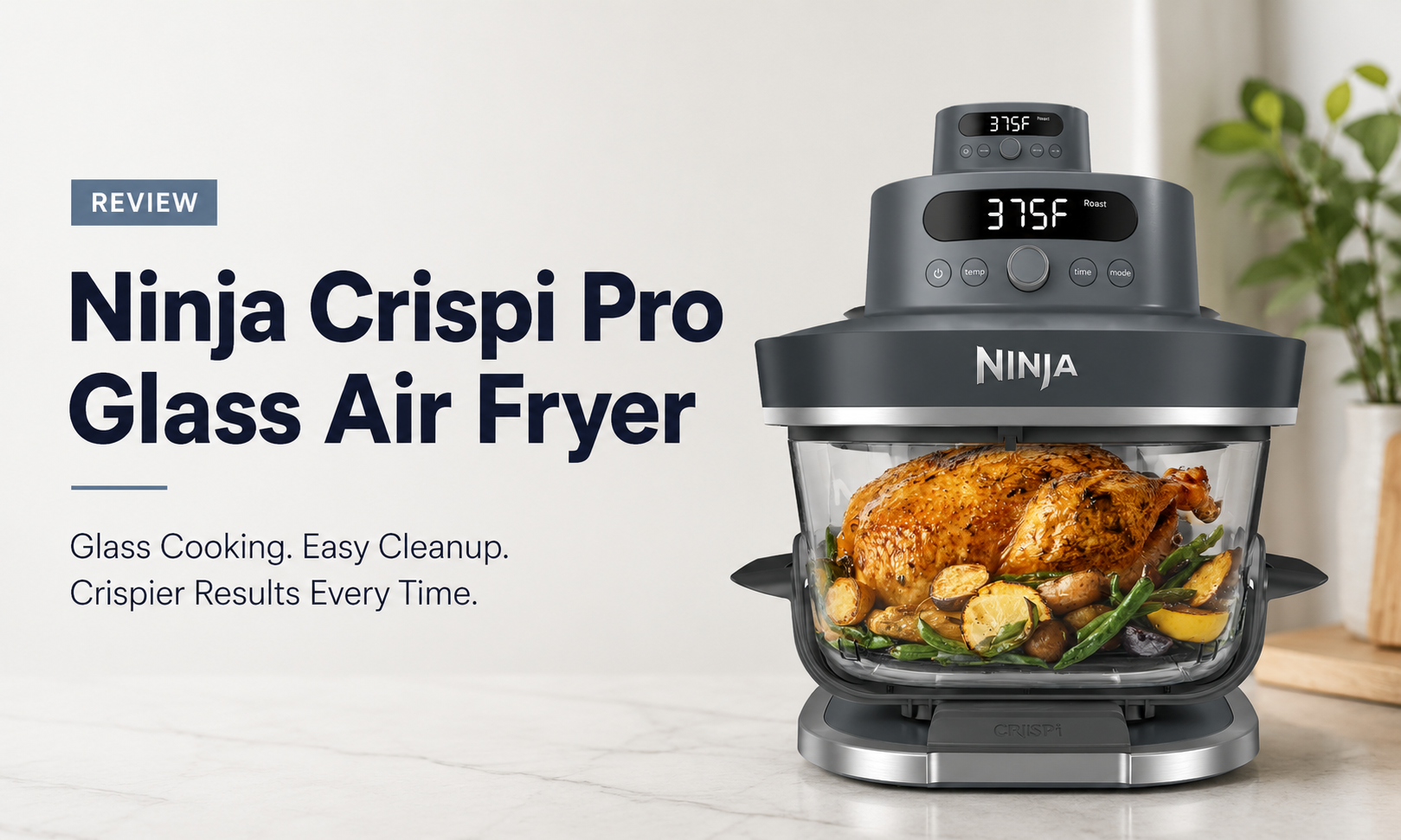
That is where the Ninja Crispi Pro Glass Air Fryer AS101CY gets interesting. Instead of building the cooking system around a conventional coated metal drawer, Ninja uses a top-mounted PowerPod with borosilicate glass cooking containers. The result is an air fryer designed around a very different idea: cook, serve, store, and reheat in the same container.
After digging through the available research, I think that workflow is the real reason to consider this machine. The cooking performance is strong in the right situations, the Recrisp function is particularly impressive, and cleanup is a major advantage. But the hot glass, heavy construction, thermal-shock precautions, and limited practical cooking surface prevent me from treating it as a universal replacement for a traditional basket air fryer.
My overall rating: ★★★★½ (4.5/5)
An unusually convenient glass air fryer that makes the most sense for material-conscious users, couples, meal preppers, and anyone who hates cleaning traditional baskets.
Ninja Crispi Pro Glass Air Fryer


My ratings at a glance
| Category | Rating | My take |
|---|---|---|
| Cooking performance | ★★★★½ 4.5/5 | Excellent browning on dry foods and strong high-heat performance. |
| Reheating | ★★★★★ 5/5 | One of its strongest reasons to buy. |
| Ease of cleaning | ★★★★★ 5/5 | Glass dramatically simplifies cleanup. |
| Design | ★★★★★ 5/5 | Distinctive, attractive, and genuinely functional. |
| Ease of use | ★★★★½ 4.5/5 | Simple controls, but handling hot glass requires adjustment. |
| Capacity | ★★★★☆ 4/5 | Good volume, but practical surface area limits large batches. |
| Handling | ★★★½☆ 3.5/5 | Heavy glass and high heat make it less convenient than a cool-touch basket. |
| Material design | ★★★★½ 4.5/5 | Excellent glass cooking vessel, although the crisper plate is ceramic-coated. |
| Noise | ★★★★½ 4.5/5 | Research places operating noise around 68 dB. |
| Long-term ownership | ★★★½☆ 3.5/5 | Glass requires care and ceramic coating longevity is an important uncertainty. |
| Overall | ★★★★½ 4.5/5 | Excellent for the right buyer. |
What makes an air fryer good in the first place?
With air fryers, wattage and maximum temperature tell only part of the story. What matters in everyday cooking is how effectively the appliance moves hot air around the food, how much usable surface area you have, how easily you can manipulate food, and how much work is required afterward.
A large nominal capacity can also be misleading. Air frying works best when food has enough space for hot air to circulate. A six-quart container does not automatically mean six quarts of food can be spread out in a single layer.
The Crispi Pro takes a different approach to several of these problems. Its glass container lets you see the food while it cooks, while the top-mounted PowerPod puts the heating element close to the food. The biggest departure, however, is what happens after cooking.
The cook, serve, store and reheat idea is genuinely useful
This is the part of the Ninja Crispi Pro that I find hardest to dismiss.
You can cook in the glass container, bring that container to the table, put the storage lid on the leftovers, refrigerate them, and later use the same container with the Recrisp function. Instead of moving food from an air fryer basket to a plate and then into a storage container, the appliance turns several steps into one workflow.
For someone who regularly cooks for one or two people, prepares meals ahead of time, or eats leftovers frequently, that can matter more than another incremental improvement in cooking speed.
Buying tip: If cleanup and leftover management are major reasons you want an air fryer, the Crispi Pro deserves considerably more attention than its unusual appearance might suggest.
How the Ninja Crispi Pro actually works
The system consists of a top-mounted heating and fan unit called the PowerPod. It locks onto either the 6-quart or 2.5-quart borosilicate glass container. Removable aluminum crisper plates sit inside the glass vessels to create airflow underneath the food.
The 6-quart container is intended for larger meals, while the 2.5-quart container makes more sense for individual portions, side dishes, and smaller reheating jobs.
The glass itself is important. Borosilicate glass has a lower coefficient of thermal expansion than ordinary soda-lime glass, making it substantially more resistant to thermal shock. That does not mean it is indestructible, however. The research makes clear that handling remains an important part of ownership.
The specifications that actually matter
| Specification | Research finding | Why it matters |
|---|---|---|
| Power | 1,800W | Supports high-temperature cooking, but can place a heavy load on a 120V circuit. |
| Maximum temperature | 450°F / 232°C | Useful for aggressive browning and reheating. |
| Large container | 6 qt / 5.7 L | Good overall volume, although usable cooking surface is the real limitation. |
| Small container | 2.5 qt / 2.3 L | Excellent for smaller portions and leftovers. |
| Weight | 11.4 lb / 5.17 kg | This is much more of a countertop appliance than something you casually put away after every use. |
| Noise | About 68 dB | Relatively restrained for a high-power air fryer. |
| Warranty | 1-year limited | Useful protection, although the research notes potential return-shipping costs. |
Where the 450°F maximum temperature matters
The 450°F ceiling gives the Crispi Pro more headroom than many air fryers that top out around 400°F. In practical terms, that matters most when you want aggressive browning, crisping, or a fast way to revive food that has lost its texture.
It is not simply a number to admire on the specification sheet. The research indicates that the combination of close heating and convection is particularly effective with dry, pre-staged foods. That is where the machine’s strengths become most obvious.
Recrisp is arguably the star of the show
If you regularly reheat pizza, fries, breaded foods, or takeout, this feature changes the value proposition considerably.
The research consistently identifies Recrisp as one of the strongest aspects of the machine. Instead of producing the soft texture associated with microwave reheating, the appliance uses convection at roughly 380°F to 400°F to remove surface moisture and restore crispness.
For a household that eats leftovers regularly, this may be more meaningful than the headline 450°F maximum temperature.
But don’t mistake six quarts for a six-quart cooking surface
This is one of the most important distinctions in the entire review.
The research notes that Ninja markets the 6-quart bowl as capable of feeding up to 10 people and accommodating a 7.5-pound chicken. Those statements describe physical volume, but they do not eliminate the basic physics of air frying.
If you pile food high enough to feed a large group, airflow becomes restricted and the food can begin steaming rather than crisping. The research therefore considers the practical optimal capacity closer to roughly four to six portions when airflow and browning matter.
Realistic expectation: Think of the 6-quart designation as a measure of container volume, not a guarantee that you can air fry a huge quantity in one evenly crisp batch.
The glass is both the best feature and the biggest responsibility
The glass gives the Crispi Pro something traditional baskets cannot: continuous visibility. You can watch food brown without repeatedly pulling out a drawer.
It also provides a non-porous cooking vessel that is free of PTFE and PFAS. That will be especially attractive to buyers who deliberately want to reduce their exposure to traditional non-stick cooking surfaces.
There is an important qualification, though. The product is not completely uncoated. The removable aluminum crisper plates use a nano-ceramic sol-gel coating. The research identifies that coating as PFAS and PTFE free, but it remains a manufactured non-stick surface and can wear over time.
The safety issue I would take seriously
The biggest weakness is not cooking performance. It is heat management.
The glass becomes extremely hot during operation. Unlike an insulated cool-touch plastic basket, the cooking vessel itself radiates substantial heat. That makes the appliance a poor fit for a crowded kitchen where children, pets, or careless hands could come into contact with the bowl.
There is also a specific thermal-shock concern. Hot glass should not be placed on a wet or cool surface, exposed to cold liquids, or aggressively cleaned while still hot. Scratches from metal utensils or abrasive cleaning can also create weaknesses that matter over repeated heating cycles.
Important: Establish a dry landing area before cooking. A suitable wooden board or heat-safe silicone surface gives the hot glass somewhere safe to rest. Do not treat the bowl like a conventional removable metal basket that can immediately go into a sink.
Cooking performance is excellent, but not universally faster
The Crispi Pro is particularly strong with dry foods and foods that benefit from intense top-down heat. Browning is one of its recurring strengths, and the research from professional testing supports that conclusion.
Dense, moist, or heavily frozen foods are a different story. The thermal mass of the glass means the system can take longer to come fully up to temperature than a thin metal basket. The research notes that foods such as thick frozen or raw chicken may require additional cooking time compared with some traditional high-velocity basket air fryers.
There is also an unusual airflow behavior. Lightweight foods can be pushed around by the concentrated airflow, sometimes producing what the research calls the “sail effect.” Thin chips, leafy vegetables, and similar foods can move around the bowl or collect in a corner.
A surprisingly entertaining airflow quirk
The same strong airflow that can bother lightweight foods produces an unexpected advantage with round foods. Small potatoes, Brussels sprouts, and meatballs can roll and rotate inside the bowl.
In effect, the airflow can act like a miniature rotating cooking system, helping spherical foods expose different sides to the heat. It is not a reason by itself to buy the machine, but it is a fascinating example of how the glass bowl changes the behavior of the airflow.
Design looks premium, but the weight is real
The glass construction gives the Crispi Pro a distinctive countertop presence. The materials feel more substantial than the lightweight plastic-and-metal construction common to conventional air fryers.
The downside is obvious: substantial glass is heavy. At 11.4 pounds, the appliance is not something I’d want to repeatedly move in and out of a cabinet. Pouring food from a hot six-quart glass container can also be awkward because the bowl requires more careful handling than a conventional basket.
The controls themselves are a stronger point. The AS101 Pro provides manual temperature adjustment up to 450°F, giving users considerably more control than the original FN101 Crispi’s preset temperature bands.
Cleaning is where the Crispi Pro earns its keep
This may be the most practical advantage of the entire design.
Borosilicate glass is non-porous, and the research repeatedly identifies easy cleanup as one of the most praised characteristics. The containers, lids, and crisper plates are dishwasher safe according to the research.
There is one caveat: frequent dishwasher use can accelerate deterioration of the ceramic coating on the crisper plates. For someone who wants to maximize the useful life of that component, gentle hand washing with a soft sponge makes more sense.
The PowerPod is different. It should never be submerged and should instead be wiped with a damp cloth after it has cooled.
Long-term ownership has a few question marks
The research identifies ceramic coating degradation as an eventual maintenance concern. Similar ceramic coatings can lose some of their non-stick characteristics with heavy use, although the exact longevity of this particular proprietary coating is not established.
Replacement crisper plates are identified in the research at approximately $10.99. Replacement glass containers are considerably more expensive, at approximately $59.99 for the 6-quart container and $43.99 for the 2.5-quart container.
Warranty support is another area where expectations should be realistic. The research describes a one-year limited warranty but notes that replacement claims may involve return shipping charges. That is not necessarily a reason to reject the product, but it is something I would factor into the ownership equation.
What real users consistently praise
- Cleanup: The glass eliminates much of the frustration associated with scrubbing a traditional basket.
- Cook-to-store workflow: Users appreciate being able to refrigerate leftovers in the same container.
- Visibility: Watching food brown without opening the appliance is frequently praised.
- Reheating: Recrisp is repeatedly highlighted as a major advantage.
- Appearance: The glass construction has strong countertop appeal.
- Material choice: Buyers specifically seeking PTFE/PFAS-free food-contact surfaces find the design attractive.
What frustrates users
- The exterior glass gets very hot.
- The six-quart bowl is heavy.
- Hot glass requires more careful handling than a cool-touch basket.
- Lightweight foods can be blown around by the airflow.
- Some dense frozen foods may take longer than expected.
- Thermal-shock precautions require a change in normal air fryer habits.
- Long-term ceramic coating durability is not fully established.
Why opinions about the Crispi Pro can differ
The polarized feedback actually makes sense once the type of user is considered.
Someone who cooks for one or two people and reheats leftovers every day may see the heavy glass as a worthwhile trade-off for dramatically easier cleanup. A large family cooking several batches of fries may have the opposite reaction because the practical surface area becomes more important than the six-quart volume.
Likewise, someone who treats the glass carefully and always uses a dry landing area may have little trouble with the material. Someone accustomed to throwing hot cookware into the sink immediately after dinner has a much steeper learning curve.
How it compares with the alternatives
| Model | Where it makes more sense | Trade-off |
|---|---|---|
| Ninja Crispi Pro AS101CY | Glass cooking, easy cleanup, Recrisp, cook-serve-store workflow | Hot, heavy glass and thermal-shock precautions |
| Ninja Crispi FN101 | Portability and lower power requirements | Less precise temperature control and smaller containers |
| Typhur Dome 2 | Large horizontal cooking surface and quiet operation | Much larger footprint and higher cost |
| Cosori TurboBlaze 6.0-Qt | Traditional basket convenience and value | Does not offer the Crispi’s glass and PFAS/PTFE-free cooking-vessel approach |
| Fritaire Glass Air Fryer | Buyers who want a stainless-steel crisper insert without ceramic coating | Lower power and a 400°F maximum temperature |
Who should buy the Ninja Crispi Pro?
- Singles and couples: The 2.5-quart container is particularly useful for smaller meals and leftovers.
- Meal preppers: Cook, refrigerate, and reheat without transferring food between multiple containers.
- People who hate air fryer cleanup: This is arguably the strongest buyer profile.
- Material-conscious shoppers: The primary glass cooking vessel avoids PTFE and PFAS.
- Leftover lovers: Recrisp is one of the machine’s standout capabilities.
- People who like visual control: The transparent container makes browning easy to monitor.
Who should avoid it?
- Families with young children: The hot exterior glass is a significant concern.
- Large-volume batch cooks: The practical cooking surface may require multiple batches.
- Rough handlers: This is not the appliance I’d choose for aggressive tossing, banging, or careless hot-to-cold handling.
- People who need portability: The Pro is considerably more suited to permanent countertop use.
- Material purists wanting absolutely no coating: The crisper plate still uses a ceramic sol-gel coating.
The buying decision in one table
| If your priority is… | I’d lean toward… | Reason |
|---|---|---|
| Easiest cleanup | Crispi Pro | Glass makes cleanup a major strength. |
| Leftover reheating | Crispi Pro | Recrisp is particularly strong. |
| Traditional easy handling | Cosori TurboBlaze | Cool-touch basket design avoids the Crispi’s hot-glass handling issues. |
| No ceramic coating | Fritaire | Its stainless-steel crisper insert better suits material purists. |
| Portability | Original Crispi FN101 | The Pro is designed more for stationary countertop use. |
| Large horizontal cooking area | Typhur Dome 2 | Better suited to single-layer batch cooking. |
Frequently asked questions
Is the Ninja Crispi Pro completely coating-free?
No. The primary cooking vessel is borosilicate glass and is free of PTFE and PFAS, but the aluminum crisper plate uses a nano-ceramic sol-gel coating.
Can the glass really handle 450°F?
The research identifies the borosilicate glass as designed to handle the temperatures used by the appliance. The greater concern is thermal shock during handling. Hot glass should not be placed on wet or cold surfaces or exposed to cold liquids immediately after cooking.
Is the Crispi Pro good for a large family?
It can physically hold a substantial amount of food, but the research suggests that optimal air frying is limited by the horizontal cooking surface. Large families may therefore need multiple batches to maintain good browning.
Is it good for reheating pizza?
Yes. Recrisp is one of the most consistently praised functions in the research and is specifically highlighted for pizza, fries, and breaded leftovers.
Can I put the PowerPod in water?
No. The PowerPod contains the heating and fan components and should not be submerged. After cooling and unplugging, it should be wiped with a damp cloth.
Can I use it in an RV?
The research says it is physically possible, but the 1,800W power requirement can create electrical limitations. Running it simultaneously with other high-draw appliances can overload a 30-amp RV circuit.
What the research still does not establish
There are two important uncertainties I would keep in mind before buying.
First, the exact long-term lifespan of the proprietary nano-ceramic coating is not established. The research points to typical ceramic-coating degradation patterns but does not provide definitive long-term testing for this specific coating.
Second, the precise grade of the BPA-free plastic used in some structural components is not documented in the research. These components are not the primary food-contact surface, but their long-term resistance to repeated thermal stress remains an unanswered question.
My final verdict: ★★★★½ (4.5/5)
The Ninja Crispi Pro AS101CY is not simply a conventional air fryer with a glass bowl. Its real selling point is the workflow it creates around that bowl.
Cook. Serve. Store. Reheat. That sequence is where the product makes the strongest argument for itself. Add the excellent cleanup, visual monitoring, strong browning on suitable foods, and impressive Recrisp performance, and there is a compelling reason for the right buyer to choose it.
But I would not buy it simply because the specification says “6 quarts” or “450°F.” Those numbers do not tell the whole story. The practical cooking surface is smaller than the volume suggests, dense frozen foods may take longer, lightweight foods can move around, and the glass requires considerably more care than a conventional basket.
The biggest issue is the heat. A hot glass cooking vessel is fundamentally different from a cool-touch drawer, and that distinction becomes particularly important in households with young children or anyone who tends to handle cookware casually.
I’d choose the Ninja Crispi Pro if my priorities were easy cleanup, leftover reheating, glass cooking, and the cook-serve-store workflow. If my priorities were maximum batch capacity, cool-touch handling, portability, or completely uncoated cooking surfaces, I’d look elsewhere.